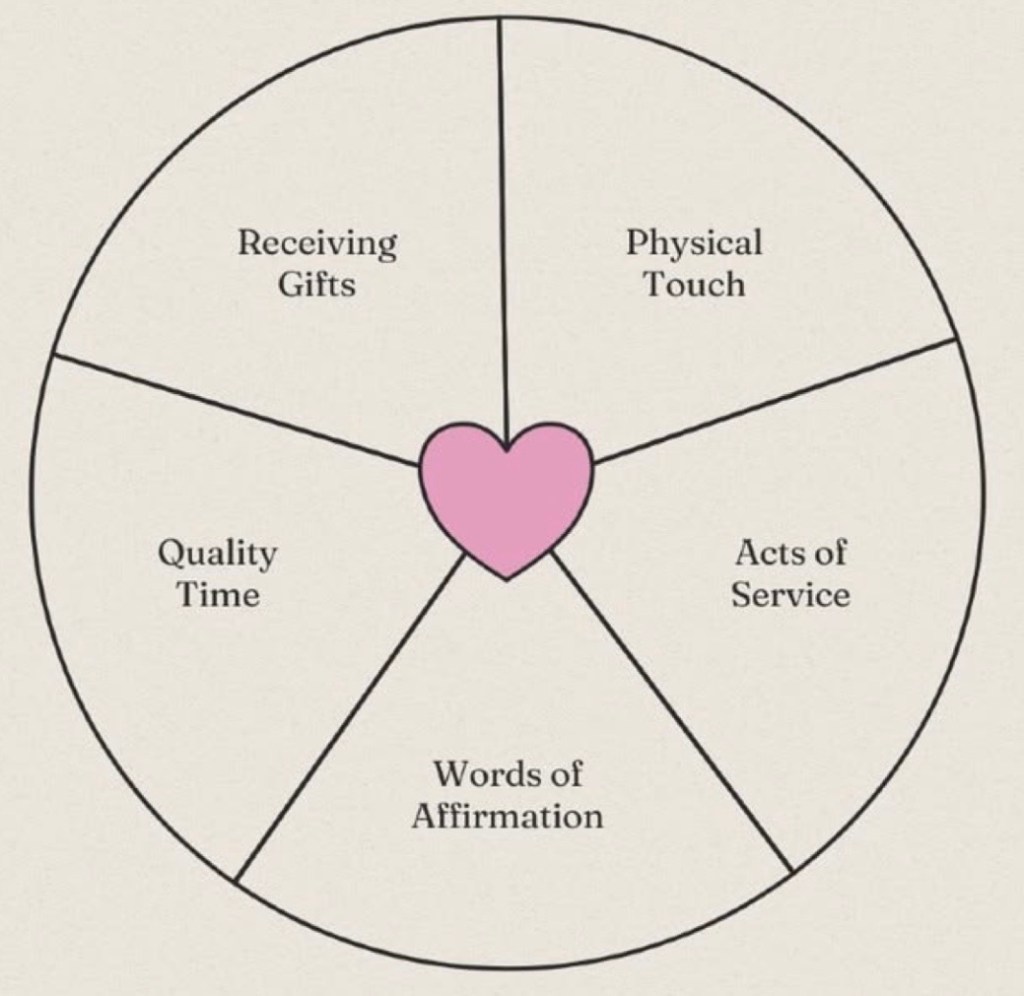
Love languages play a key role in relationships as partners discover how their significant other display and accept love. There are five well known love languages, these being physical touch, words of affirmation, acts of service, gift giving/receiving, and quality time. Love languages are important as they prevent miscommunication, allow for more fulfilling relationships, help others understand your emotional needs, and can be used to reduce conflict. When we understand our partners, or friends, love languages we are able to see and understand them in a way that makes them feel safe and secure with us. With distance, some of these love languages may be harder to display than others, but this is where effort plays a significant role.
What exactly are love languages? Love languages are a part of relational maintenance, and can be used as a tool in managing your relationship. Gary Chapman, the theorist who set the base for this concept, stated that, “relationships may be particularly satisfying for both partners if both regularly express affection in a manner consistent with the other partner’s preference.” (Chapman, 1992). In order to understand your partner’s love language you should have conversations regarding how they feel appreciated or cared for. Once learning your partner’s love language, there are three fundamental aspects to acting and displaying them. The first aspect is understanding, and this involves “having knowledge of the partner including a specific desire in question.” (Coy, 2023). The second aspect is validating, which means you are valuing your partner, and acknowledging the need that they want you to fulfill. The final aspect is caring, which can be acknowledged by expressing that you care about your partners’ well-being and displayed by fulfilling the need that they have expressed to you. To fully understand your partners’ love language, communication and honest conversations are necessary.
One of the biggest hurdles when couples learn each other’s love language, is when their languages don’t align. There are five love languages, and for the most part, your partner’s love language will not be the same as yours. Relationship Dialects Theory emphasizes how it is natural to have tensions in a relationship as both partners have differing emotional needs. In an article by Selena Bunt and Zoe Hazelwood, it is suggested that, “relationships are strengthened when both partners in a relationship speak the same language. Conversely, relationships are challenged when one partner’s primary way of expressing love differs from that of the other.” (Bundt & Hazelwood, 2017). While this can be a challenge for some, it can easily be navigated as long as you communicate with your partner the best way to fulfill their needs. In an article by Jennifer Hughes and Abigail Camden, it is mentioned that “partners have emotional love tanks. An empty love tank can cause romantic withdrawal, harsh interactions, or inappropriate behaviors. Couples with a full love tank are able to deal with conflict and cope with their differences.” (Hughes & Camden, 2020). This helps to illustrate the importance in knowing your partner’s love language, but also understanding their love language. We can view this under the Uncertainty Reduction theory as you can learn your partners’ love language in order to reduce uncertainty within your relationship expectations. Couples who put in the emotional and physical effort to understand their partner’s love language often feel more overall relationship satisfaction.
The five love languages consist of words of affirmation, acts of service, receiving gifts, quality time, and physical touch. Words of affirmation can be displayed through verbal or written words expressed to your partner. Examples of this love language could be writing your partner a hand written note, verbally complimenting or encouraging your partner, or send a thoughtful text throughout the day. In an article by Kory Floyd, it is stated that “one reason why sharing affectionate communication may benefit marital partners is that it may help to defuse the negative mental and physical effects of stress. (Floyd & Riforgiate, 2008). Words of affirmation is the easiest love language to manage in a long-distance relationship as you often will use technology as your main source of communication with your partner.
The next love language is acts of service. This love language can be displayed by doing something for your partner that will help them out or make their life easier. An example of this would be folding your partner’s laundry, taking their car to the car wash, or running errands for them. This love language is somewhat manageable in long-distance relationships. While it is difficult to perform acts that require your physical presence, such as cooking a meal, there are still ways in which you can help make your partner’s life easier from afar. This could look like ordering mobile deliveries to your partner for their groceries or food when they are sick.
The next love language is receiving gifts. This love language is not just about buying any gifts for your partner, but about the thought behind the gift. In an article by Colleen Kirk it is mentioned that “gift giving has well-being, social, and identity effects for givers and recipients.” (Kirk et al., 2025). This love language is pretty manageable in long distance relationships as you can send gifts to your partner, or have them delivered straight to their front door. This can look like sending your partner a blanket with their favorite character on it, or sending them a piece of jewelry with your initial engraved on it.
The fourth love language is quality time. The quality time to love language requires giving an individual your full attention and spending meaningful time together. Not all time is quality time. Quality time is defined by Ashley Whillians as, “the perception of spending enjoyable time together, and it is critical for preserving relationship satisfaction.” (Whillians et al., 2025). This love language is manageable in long distance relationships, as long as both parties are willing to put in the effort to make time for meaningful time. Couples can hop on Facetime at any point of the day, but are there distractions? Is one person doing homework? Is the other playing video games? Quality time over the phone looks like your partner and the conversation are the main focus and priority of the call. I again want to stress that not all time is quality time. The last love language and the most difficult love language to manage in long-distance relationships is physical touch. The physical touch love language is displayed through expressing love through physical touch. While this is the one love language that long-distance relationships cannot physically do, it makes in-person interactions that much more special.
Love languages are gateways into your partners’ heart. The more you learn about your partner and their love language, the more you will be able to understand them and their needs. Understanding your partner’s love language does not fully diminish all relationship conflict, however it helps in navigating conflict in more productive ways. When you understand what your partner needs and you fulfill that need, the overall relationship satisfaction rises on both ends.
Discussion Questions
- In what ways can couples navigate differences when their love languages do not align?
- Can love languages change over time?
- How does fulfilling a partner’s love language impact conflict, emotional security, and relationship satisfaction?
References
Bunt, S., & Hazelwood, Z. J. (2017). Walking the Walk, Talking the Talk: Love languages, Self-regulation, and Relationship Satisfaction. Personal Relationships, 24(2), 280–290. https://doi-org.lib-proxy.fullerton.edu/10.1111/pere.12182
Coy, A. E., & Rodriguez, L. M. (2023). Affection Preference, Enactment, and Relationship Satisfaction: A Dyadic Analysis of Love Languages. Journal of Marital & Family Therapy, 49(4), 741–761. https://doi-org.lib-proxy.fullerton.edu/10.1111/jmft.12655
Floyd, K., & Riforgiate, S. (2008). Affectionate Communication Received from Spouses Predicts Stress Hormone Levels in Healthy Adults. Communication Monographs, 75(4), 351–368. https://doi-org.lib-proxy.fullerton.edu/10.1080/03637750802512371
Hughes, J. L., & Camden, A. A. (2020). Using Chapman’s Five Love Languages Theory to Predict Love and Relationship Satisfaction. Psi Chi Journal of Psychological Research, 25, 234–244. https://doi-org.lib-proxy.fullerton.edu/10.24839/2325-7342.JN25.3.234
Kirk, C. P., Sedikides, C., & Givi, J. (2025). Just Because I’m Great (and You’re Not): When, Why, and How Narcissistic Individuals Give Gifts to Others. Journal of Personality, 93(4), 895–912. https://doi-org.lib-proxy.fullerton.edu/10.1111/jopy.12983
Whillans, A., Pow, J., & Gladstone, J. (2025). Buying (Quality) Time Predicts Relationship Satisfaction. Journal of Personality & Social Psychology, 128(4), 821–863. https://doi-org.lib-proxy.fullerton.edu/10.1037/pspi0000488
 Managing Long Distance Relationships Through Technology
Leave a comment